Minna no Nihongo Lesson 43 – Listening & Practice Exercises

These exercises focus on advanced reasoning and viewpoint explanation, assessing academic-style discourse comprehension.

Listening Questions

Exercise 1: Listen and answer the questions


1) _______________________

2) _______________________

3) _______________________

4) _______________________

5) _______________________


1)

««« Answers »»»

あなたの (くに)で 日本語(にほんご)を 勉強(べんきょう)する (ひと)は これから ()えそうですか、()りそうですか。
From now on, does the number of people studying Japanese in your country seem to be increasing or decreasing?

(れい): ()えそうです。
It seems to be increasing.

2)

««« Answers »»»

日本(にほん)の (えん)は これから (たか)く なりそうですが、(やす)く なりそうですか。
From now on, does the Japanese yen seem likely to get more expensive or cheaper?

(れい): (やす)く なりそうです。
It seems to be getting cheaper.

Exercise 2: Listen and choose True/False


1)(__)2)(__)3)(__)4)(__)5)(__)


1) 

««« Script »»»
(おとこ)
やっと (あたた)かく なりましたね。
It's finally gotten warm.
(おんな)
ええ。
Yeah.
(おとこ)
もうすぐ (さくら)が ()きそうですね。
It looks like the cherry blossoms are about to bloom.
(おんな)
ことしも どこか 花見(はなみ)に ()きますか。
Shall we go somewhere to see the blossoms again this year?
(おとこ)
ええ、上野公園(うえのこうえん)へ ()こうと (おも)って います。
Yes, I'm thinking of going to Ueno Park.
(いま) (さくら)が ()いて います。
The cherry blossoms are in bloom now.
Answers

2) 

««« Script »»»
(おんな)
このごろ うれしそうですね。(なに)か あったんですか。
You seem happy lately. What's up?
(おとこ)
ええ、()どもが ()まれるんです。
Oh, we're having a baby.
(おんな)
それは おめでとう ございます。
Congratulations!
 
いつごろですか。
Around when?
(おとこ)
9(がつ)の 予定(よてい)なんです。
It's due in September.
(おとこ)の (ひと)は ()どもが ()まれるので、うれしそうです。
The man seems happy because his child is going to be born.
Answerd

3) 

««« Script »»»
(おんな)
あ、財布(さいふ)を (わす)れてしまいました。ちょっと()ってきます。
Oh, I forgot my wallet. I'll go get it.
(おとこ)
そうですか。じゃ、()っていますよ。
I see. I'll wait, then.
(おんな)
すみません。
Excuse me.
(おんな)(ひと)は 財布(さいふ)を ()りに ()きます。
The woman goes to get her wallet.
Answerd

4) 

««« Script »»»
(おとこ)
京都(きょうと)旅行(りょこう)に ()かないんですか。
Aren't you going on a trip to Kyoto?
(おんな)
ええ、ちょっと 用事(ようじ)が あって。
No, I'm a bit busy.
(おとこ)
それは 残念(ざんねん)ですね。
That's a shame.
 
じゃ、お土産(みやげ) ()って ()ます。
Then I'll bring back some souvenirs.
(おとこ)
ありがとう ございます。写真(しゃしん)も ()せて くださいね。
Thanks. Please show me the photos, too.
(おとこ)の (ひと)は 旅行(りょこう)に ()って、お土産(みやげ)を ()います。
The man goes on the trip and buys souvenirs.
Answerd

5) 

««« Script »»»
(おとこ)
(あめ)が ()りそうだね。
Looks like it's going to rain.
(おんな)
ええ。
Yeah.
(おとこ)
(かさ)を ()って ()こうか。
Shall I bring an umbrella?
(おんな)
ええ、そうした ほうが いいね。
Yeah, we should.
(あめ)が ()って いますから、(おとこ)の (ひと)と (おんな)(ひと)は (かさ)を ()って ()きます。
Because it's raining, the man and the woman take umbrellas with them.
Answers

Practice Questions

Exercise 3: Fill in the blanks with the appropriate words

(れい):うしろの ポケットから ハンカチが (())そうですよ。

  …  あ、ほんとうだ。どうも。

1)荷物(にもつ)が (おも)くて、(ふくろ)が(___)そうです。

  …  じゃ、これを 使(つか)って ください。

2)今日(きょう) (あつ)く(___)そうです。

  …  じゃ、帽子(ぼうし)を ()って ()きます。

3)(いそ)ぎましょう。時間(じかん)に(___)そうですよ。

  …  じゃ、タクシーで ()きましょう。

4)ずいぶん (さむ)く なりましたね。

  …  ええ、(ゆき)が(___)そうですね。

Answer key and translation

(れい):うしろの ポケットから ハンカチが ( () )そうですよ。
Your handkerchief is about to fall out of your back pocket.

  …  あ、ほんとうだ。どうも。
Oh, you're right. Thanks.

1)荷物(にもつ)が (おも)くて、(ふくろ)が ( (やぶ)れ )そうです。
The bag is about to tear because it's heavy.

  …  じゃ、これを 使(つか)って ください。
Then use this.

2)今日(きょう) (あつ)く ( なり )そうです。
It looks like it's going to be hot today.

  …  じゃ、帽子(ぼうし)を ()って ()きます。
Then bring a hat.

3)(いそ)ぎましょう。時間(じかん)に ( (おく)れ )そうですよ。
Hurry up. We're going to be late.

  …  じゃ、タクシーで ()きましょう。
Then let's take a taxi.

4)ずいぶん (さむ)く なりましたね。
It's gotten quite cold, hasn't it?

  …  ええ、(ゆき)が ( ()り )そうですね。
Yes, it looks like it's going to snow.

Exercise 4: Fill in the blanks with the appropriate word

(れい) 1:どう したんですか。気分(きぶん)が ((あく))そうですね。

  …  ええ、ちょっと (つか)れて いるんです。

(れい) 2:(元気(げんき))そうですね。

  …  ええ、スポーツを (はじ)めてから、(からだ)の 調子(ちょうし)が いいんです。

1)わあ、(______)そうですね。ワンさんが (つく)ったんですか。

  …  ええ、中国(ちゅうごく)の 料理(りょうり)です。どうぞ。

2)この お(てら)、すいぶん(___)そうですね。いつ できたんですか。

  …  500(ねん)ぐらいめに ()てられました。

3)その かばんは(___)そうですよ。

  …  ええ、(おも)い (もの)を ()れても、大丈夫(だいじょうぶ)です。

4)その かばん、旅行(りょこう)に(___)そうですね。

  …  ええ、(かる)いし、ポケットも たくさん あるんです。

Answer key and translation

(れい)1:どう したんですか。気分(きぶん)が ( (あく) )そうですね。
What's wrong? You don't seem to be in good spirits.

    …  ええ、ちょっと (つか)れて いるんです。
Yes, I'm a little tired.

(れい) 2:( 元気(げんき) )そうですね。
You look well.

    …  ええ、スポーツを (はじ)めてから、(からだ)の 調子(ちょうし)が いいんです。
Yeah, since I started playing sports, I've gotten healthier.

1)わあ、( おいし )そうですね。
Oh, that looks delicious.
ワンさんが (つく)ったんですか。
Did Mr. Wang make it?

  …  ええ、中国(ちゅうごく)の 料理(りょうり)です。どうぞ。
Yes, it's Chinese food. Please help yourself.

2)この お(てら)、すいぶん ( ()る )そうですね。
This temple looks quite old.
いつ できたんですか。
When was it built?

  …  500(ねん)ぐらいまえに ()てられました。
It was built about 500 years ago.

3)その かばんは ( 丈夫(じょうぶ) )そうですよ。
This bag seems sturdy.

  …  ええ、(おも)い (もの)を ()れても、大丈夫(だいじょうぶ)です。
Yes, it's fine even if you put heavy things in it.

4)その かばん、旅行(りょこう)に ( 便利(べんり)/よさ )そうですね。
That bag looks handy for traveling.

  …  ええ、(かる)いし、ポケットも たくさん あるんです。
Yes, it's light and has lots of pockets.

Exercise 5: Choose the appropriate word, change its form, and fill in the blanks
()きます
()います
()きます
()ります
()びます

(れい):どうしたんですか。

  …  財布(さいふ)を (わす)れたので、 ちょっと ( ()って ) ()ます。

1)ちょっと 休憩(きゅうけい)しませんか。

  …  じゃ、コーヒーでも(___) ()ましょう。

2)空港(くうこう)へ ()く バスの ()()は どこでしょうか。

  …  さあ。あの (みせ)で(___) ()ましょう。

3)課長(かちょう)が ミラーさんを (さが)して いますよ。

  …  食堂(しょくどう)に いると (おも)いますから、すぐ(___) ()ます。

4)コンビニへ ()きますが、(なに)か 用事(ようじ)が ありませんか。

  …  じゃ、お弁当(べんとう)を(___) ()てください。

Answer key and translation

(れい):どうしたんですか。
What's wrong?

  …  財布(さいふ)を (わす)れたので、 ちょっと ( ()って ) ()ます。
I forgot my wallet. I'll go get it and come right back.

1)ちょっと 休憩(きゅうけい)しませんか。
Shall we take a break?

  …  じゃ、コーヒーでも ( いれて ) ()ましょう。
In that case, I'll go make some coffee and bring it back.

2)空港(くうこう)へ ()く バスの ()()は どこでしょうか。
Where do we catch the bus to the airport?

  …  さあ。あの (みせ)で ( ()いて ) ()ましょう。
Ah, try asking at that shop over there.

3)課長(かちょう)が ミラーさんを (さが)して いますよ。
The section chief is looking for Mr. Miller.

  …  食堂(しょくどう)に いると (おも)いますから、すぐ ( ()んで ) ()ます。
I think he's in the cafeteria, so I'll go get him right away.

4)コンビニへ ()きますが、(なに)か 用事(ようじ)が ありませんか。
I'm going to the convenience store. Do you need anything?

  …  じゃ、お弁当(べんとう)を ( ()って ) ()てください。
Then please get me a boxed lunch.

Exercise 6: Read the following passage and mark True or False for the sentences below


あけみさんの 日記(にっき)を ()いて ください。

(がつ)13(にち)(にち)) きょう (①  )に ()った。そこで (②  )と ()()った。(しず)かで、(あたま)が よさそうだ。

(がつ)21(にち)()) わたしの (③  ) に 鈴木(すずき)さんが ()て くれた。 プレゼントに (④  )を たくさん くれた。 パーティーの あとで、(かれ)が (⑤  ) に (さそ)って くれた。 わたしの ことが ()きかも しれない。 わたしも (かれ)が ()きだ。

(がつ)15(にち)(きん)) (かれ)と けんかを した。 どうして けんかに なったか、わからない。

11(がつ)16(にち)(にち)) きょう (かれ)が わたしに 「(⑥  )」と ()った。 うれしくて、()いて しまった。 もちろん 「はい」と (こた)えた。 ほんとうに (しあわ)せ。

Translation and answer key


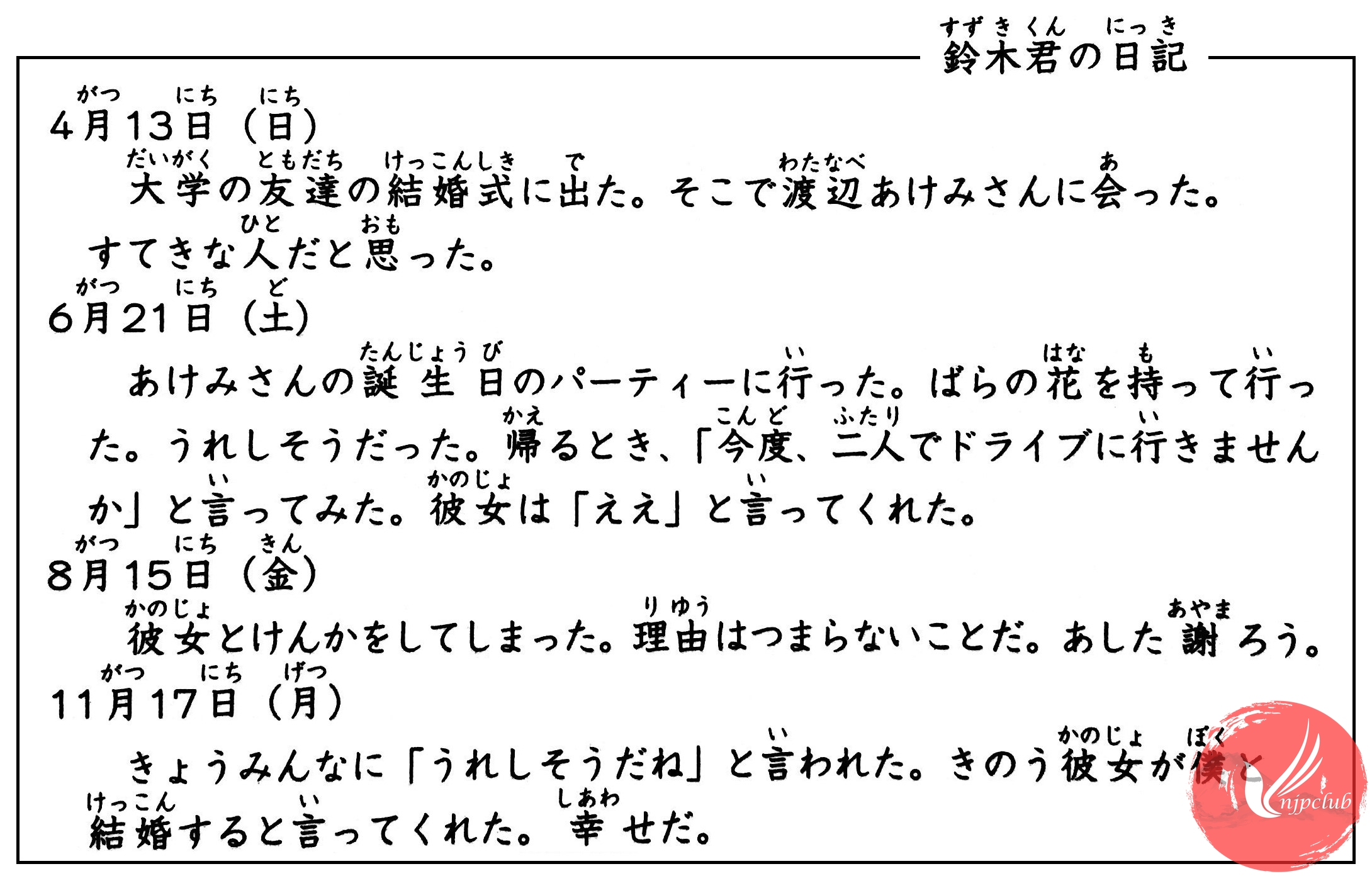
                           鈴木(すずき)(くん)の 日記(にっき)
Suzuki's diary.

4(がつ)13(にち)(にち)
April 13 (Sunday).

       大学(だいがく)の 友達(ともだち)の 結婚式(けっこんしき)に ()た。
Attended a college friend's wedding.
そこで 渡辺(わたなべ)あけみさんに ()った。
Met Watanabe Akemi there.
すてきな (ひと)だと (おも)った。
I thought she was a wonderful person.

6(がつ)21(にち)()
June 21 (Saturday).

        あけみさんの 誕生日(たんじょうび)の パーティーに ()った。
Went to Akemi's birthday party.
ばらの (はな)を ()って ()った。
Brought a bouquet of roses.
うれしそうだった。
She looked very happy.
(かえ)る とき、「今度(こんど) 二人(ふたり)で ドライブに ()きませんか。」と ()って みた。
On the way back, I asked, 'Shall we go for a drive next time?'
彼女(かのじょ)は 「ええ」と ()って くれた。
She said, 'Sure.'

(がつ)15(にち)(きん)
August 15 (Friday).

      彼女(かのじょ)と けんかを してしまった。
We had a fight.
理由(りゆう)は つまらないことだ。
The reason was something trivial.
あした (あやま)ろう。
I'll apologize tomorrow.

11(がつ)17(にち)(げつ)
November 17 (Monday).

      きょう みんなに 「うれしそうだね」と ()われた。
Today everyone said, 'You look so happy.'
きのう 彼女(かのじょ)が (ぼく)と 結婚(けっこん)すると ()って くれた。
Yesterday she said she would marry me.
(しあわ)せだ。
I'm so happy.


あけみさんの 日記(にっき)を ()いて ください。
Write Akemi's diary.

(がつ)13(にち)(にち)
On April 13 (Sunday).
 
きょう (① 友達(ともだち)の」結婚式(けっこんしき) )に ()った。
Today I attended a friend's wedding.
そこで (② 鈴木(すずき)さん )と ()()った。
I met Mr. Suzuki there.
(しず)かで、(あたま)が よさそうだ。
He seemed quiet and intelligent.

(がつ)21(にち)()) 
On June 21 (Saturday).
わたしの (③ 誕生日(たんじょうび)のパーティー ) に 鈴木(すずき)さんが ()て くれた。
Mr. Suzuki came to my birthday party.
プレゼントに (④ ばらの(はな) )を たくさん くれた。
He brought lots of roses.
パーティーの あとで、(かれ)が (⑤ ドライブ ) に (さそ)って くれた。
After the party, he invited me to go for a drive.
わたしの ことが ()きかも しれない。
Maybe he likes me.
わたしも (かれ)が ()きだ。
And I like him too.

(がつ)15(にち)(きん)) 
On August 15 (Friday).
(かれ)と けんかを した。
He and I had a fight.
どうして けんかに なったか、わからない。
I don't even know why we argued.

11(がつ)16(にち)(にち)) 
On November 16 (Sunday).
きょう (かれ)が わたしに 「(⑥ 結婚(けっこん)してください )」と ()った。
Today he said to me, 'Will you marry me?'
うれしくて、()いて しまった。
I was overjoyed and burst into tears.
もちろん 「はい」と (こた)えた。
Of course I said "Yes".
ほんとうに (しあわ)せ。
I was truly happy.

Exercise 7: Application

週末(しゅうまつ)の 日記(にっき)を ()いて ください。