Part 1: Affirmative and negative forms of nouns
Structure |
| | | N | Affirmative | Negative | |
N
です
|
N
ではありません
N
じゃありません
|
|
| | Meaning |
|
☞
| Affirmative: is ~ Negative: is not ~
※です Nouns combine with です to form the predicate. です expresses both judgment/affirmation and a polite attitude toward the listener. ※ じゃ ありません is commonly used in everyday conversation. では ありません is typically used in speeches and in writing. |
| | Examples |
|
1.
| |
|
2.
| |
Part 2: Particle は
Structure |
|
~ は ~
|
| Explanation & Guidance |
|
☞
| The noun before は is the topic of the sentence. It is used to introduce a topic the speaker wants to talk about. は can be used to separate the subject and the predicate in a sentence.
※ は is pronounced wa(わ). |
| | Examples |
|
1.
| |
|
2.
| |
Part 3: Questions
| Structure |
|
~ は Nです
か。
Nじゃありません
か。
|
| | Meaning |
| | Is it ~? |
| | Explanation & Guidance |
|
☞
| The character か is placed at the end of a sentence to make a question. It indicates the speaker’s uncertainty or doubt.
※ The end of a question is pronounced with a higher pitch. |
| | Examples |
|
1.
| |
|
2.
| たなかさんは いしゃじゃありませんか。
Mr. Tanaka isn't a doctor, right? |
Part 3-1: Yes-no questions
Structure |
|
| A: ~は Nですか。 B: はい、Nです。 いいえ、Nじゃありません。N1です。 |
|
| Explanation & Guidance |
|
☞ | This is a confirmation question used to determine whether the information is correct or not. When answering, you must begin with はい (yes) or いいえ (no). |
|
| Examples |
|
1. | A: シュミットさんは ドイツじんですか。 A: Is Mr. Schmidt German? |
|
2. | |
Part 3-2: Wh-questions
Structure |
|
| A: ~は interrogative word ですか。 B: Nです。 |
|
| Explanation & Guidance |
|
☞ | Replace the part you want to ask about with a question word. Question words are used to ask things like: who? what? where? how old? how much? ... For this type of question, we answer directly without はい or いいえ. |
|
| Examples |
|
1. | |
|
2. | |
Part 4: Particle も
Structure |
| |
~ も ~
|
| | Meaning |
| | Also ~ |
| | Explanation & Guidance |
|
☞
| Used when something is repeated from the previous sentence. When the repeated element is omitted, も is also omitted. |
| | Examples |
|
1.
|
A: たなかさん
は
じゅうはっさいです。やまださん
も
じゅうはっさいですか。
A: Tanaka is 18. Yamada is also 18, right? |
|
2.
|
わたし
は
がくせいじゃありません。はらださん
も
がくせいじゃありません。
I am not a student. Mr. Harada isn't a student either. |
Part 5: Particle の
Structure |
| |
N
1 の N
2
|
| | Meaning |
| | Of... |
| | Explanation & Guidance |
|
☞
| の is used to connect two nouns. Here, N
2 is the main idea, and N1 modifies N2. In Lesson 1, N1 indicates the place to which N2 belongs. |
| | Examples |
|
1.
|
ふじだいがくの がくせいです。
A student at Fuji University. |
|
2.
|
さくらだいがくの せんせいです。
A teacher at Sakura University. |
Part 6: Asking someone's age
Structure |
| |
~は
おいくつですか。
なんさい
|
| | Meaning |
|
☞
| ~ how old? |
| | Explanation & Guidance |
|
☞
| Use なんさい or おいくつ to ask someone's age. おいくつ is the more polite way to ask. |
| | Examples |
|
1.
|
A: やまだせんせいは おいくつですか。
A: How old is Mr. Yamada?
B: やまだせんせいは よんじゅっさいです。
B: Mr. Yamada is 40 years old. |
|
2.
| |
Part 7: ~さん、~ちゃん
Structure |
|
| Nさん |
|
| Explanation & Guidance |
|
☞ | さん is used after the surname or given name of the listener or a third person. Do not use it after your own name. For children, use ちゃん, which is more intimate, instead of さん. ちゃん can be used for both boys and girls; you do not have to distinguish between ちゃん for girls and くん for boys as previously learned. |
|
| Examples |
|
1. | |
|
2. | A: タワポンさんは がくせいですか。 A: Is Mr. Thawaphon a student? |
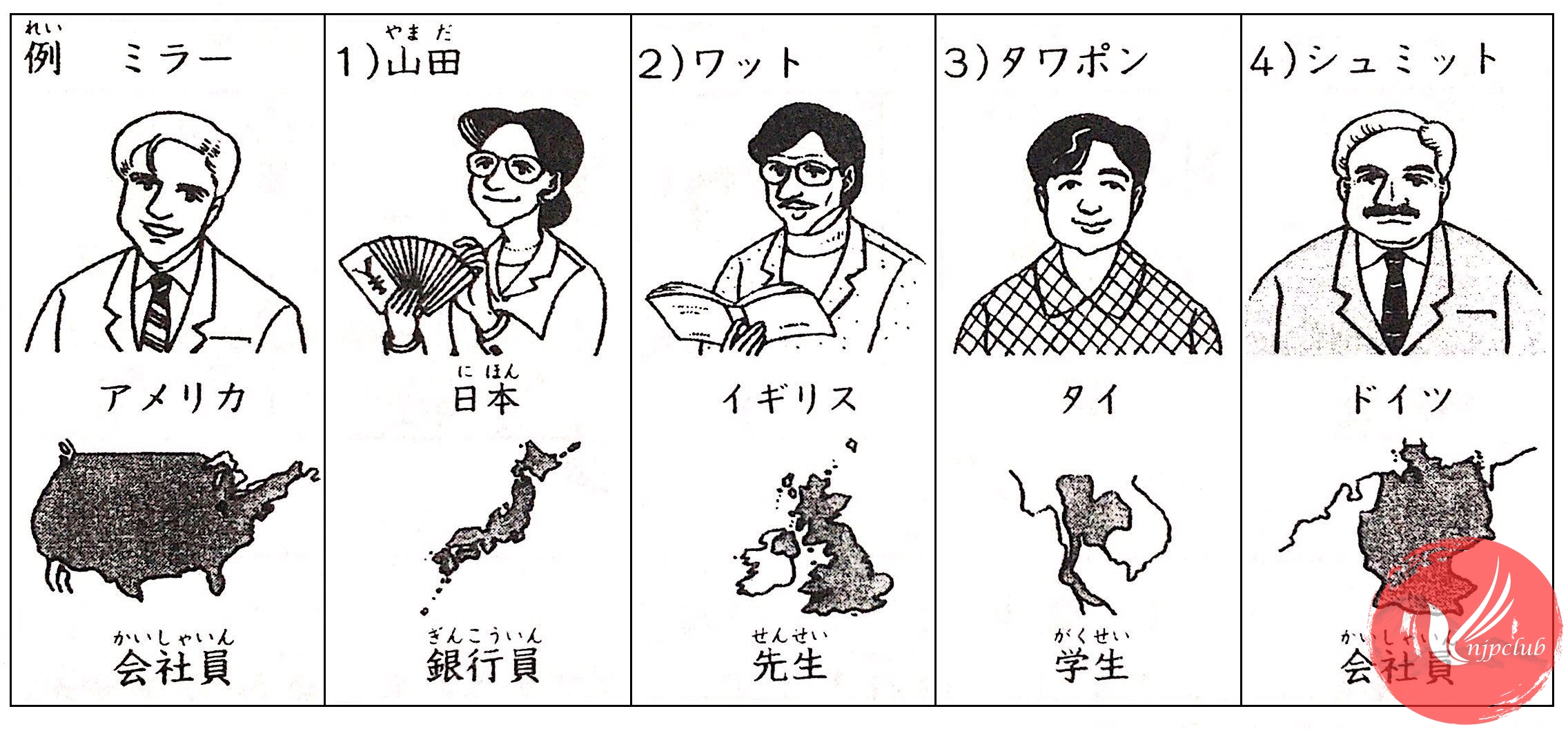
Part 1: Complete sentences similar to the example using the information in the picture

例
: ⇒ ミラーさんは アメリカじん です。
Complete the following sentences:
1)⇒ 2)⇒ 3)⇒ 4)⇒
Part 2: Complete sentences similar to the example using the information in the picture
例
: ⇒ ミラーさんは かいしゃいんです。
Complete the following sentences:
1)⇒ 2)⇒ 3)⇒ 4)⇒
««« Answer key »»»
1)やまださんは ぎんこういん です。
Ms. Yamada is a bank employee.
3)タワポンさんは がくせい です。
Mr. Thawaphon is a student.
4)シュミットさんは かいしゃいん です。
Mr. Schmidt is a company employee.
Part 3: Complete sentences similar to the example using the information in the picture
例
: ミラーさん・ぎんこういん
⇒ ミラーさんは ぎんこういんじゃ ありません。
Mr. Miller is not a bank employee.
Complete the following sentences:
1)やまださん・がくせい ⇒
2)ワットさん・
ドイツ
人
⇒
3)タワポンさん・せんせい ⇒
4)シュミットさん・アメリカじん ⇒
««« Answer key »»»
1)やまださん・がくせい
⇒ やまださんは がくせいじゃ ありません。
Ms. Yamada is not a student.
2)ワットさん・ドイツじん
3)タワポンさん・せんせい
⇒ タワポンさんは せんせいじゃ ありません。
Mr. Thawaphon is not a teacher.
4)シュミットさん・アメリカじん
⇒ シュミットさんは アメリカじんじゃ ありません。
Mr. Schmidt is not American.
Part 4: Complete sentences similar to the example using the information in the picture
例
1:
ミラーさん・アメリカじん
例
2
:
ミラーさん・いしゃ
⇒ ミラーさんは いしゃですか。
Mr. Miller is a doctor, right?
Complete the following sentences:
1)やまださん・ぎんこういん ⇒
2)ワットさん・かいしゃいん ⇒
3)タワポンさん・せんせい ⇒
4)シュミットさん・ドイツじん ⇒
««« Answer key »»»
1)やまださん・ぎんこういん
⇒ やまださんは ぎんこういんですか。
Ms. Yamada is a bank employee, right?
……はい、ぎんこういんです。
…… Yes, she is a bank employee.
2)ワットさん・かいしゃいん
⇒ ワットさんは かいしゃいんですか。
Mr. Watt is a company employee, right?
……いいえ、かいしゃいんじゃ ありません。
No, he is not a company employee.
3)タワポンさん・せんせい
⇒ タワポンさんは せんせいですか。
Mr. Thawaphon is a teacher, right?
……いいえ、せんせいじゃ ありません。
…… No, I'm not a teacher.
4)シュミットさん・ドイツじん
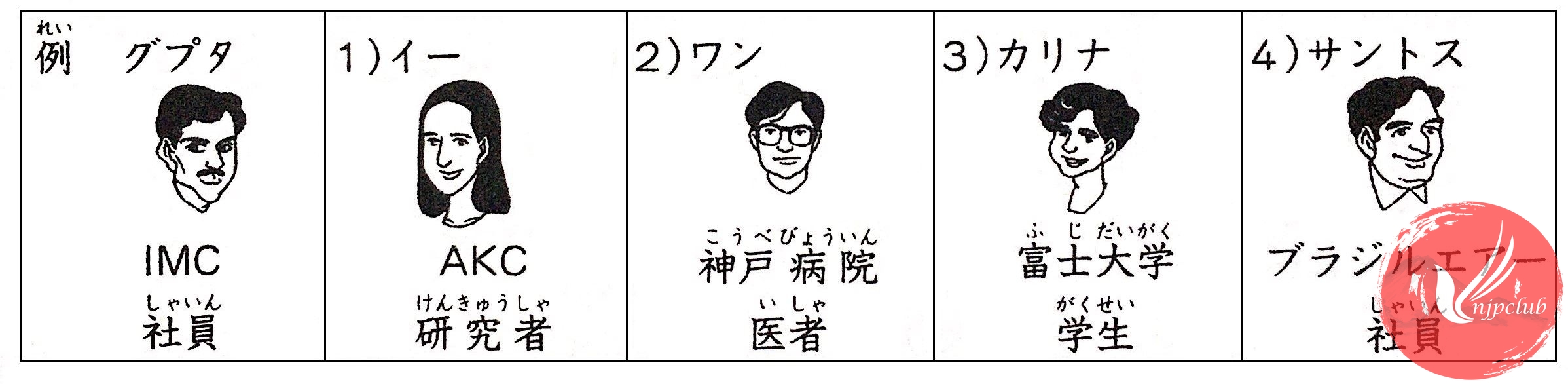
Part 5: Complete sentences similar to the example using the information in the picture

例
:
… グプタさんです。IMCのしゃいんです。
That's Gupta. An employee at IMC.
Complete the following sentences:
1)⇒
2)⇒
3)⇒
4)⇒
««« Answer key »»»
1)あの かたは どなたですか。
Who is that person over there?
… イーさんです。AKCのけんきゅうしゃです。
That's Ms. Lee. A research student at AKC.
2)あの かたは どなたですか。
Who is that person over there?
… ワンさんです。こうべびょういんの いしゃです。
That's Mr. Wang. A doctor at Kobe Hospital.
3)あの かたは どなたですか。
Who is that person over there?
… カリナさんです。ふじだいがくの がくせいです。
That's Ms. Karina. A student at Fuji University.
4)あの かたは どなたですか。
Who is that person over there?
… サントスさんです。ブラジルエアーのしゃいんです。
That's Mr. Santos. An employee at Brazil Air.
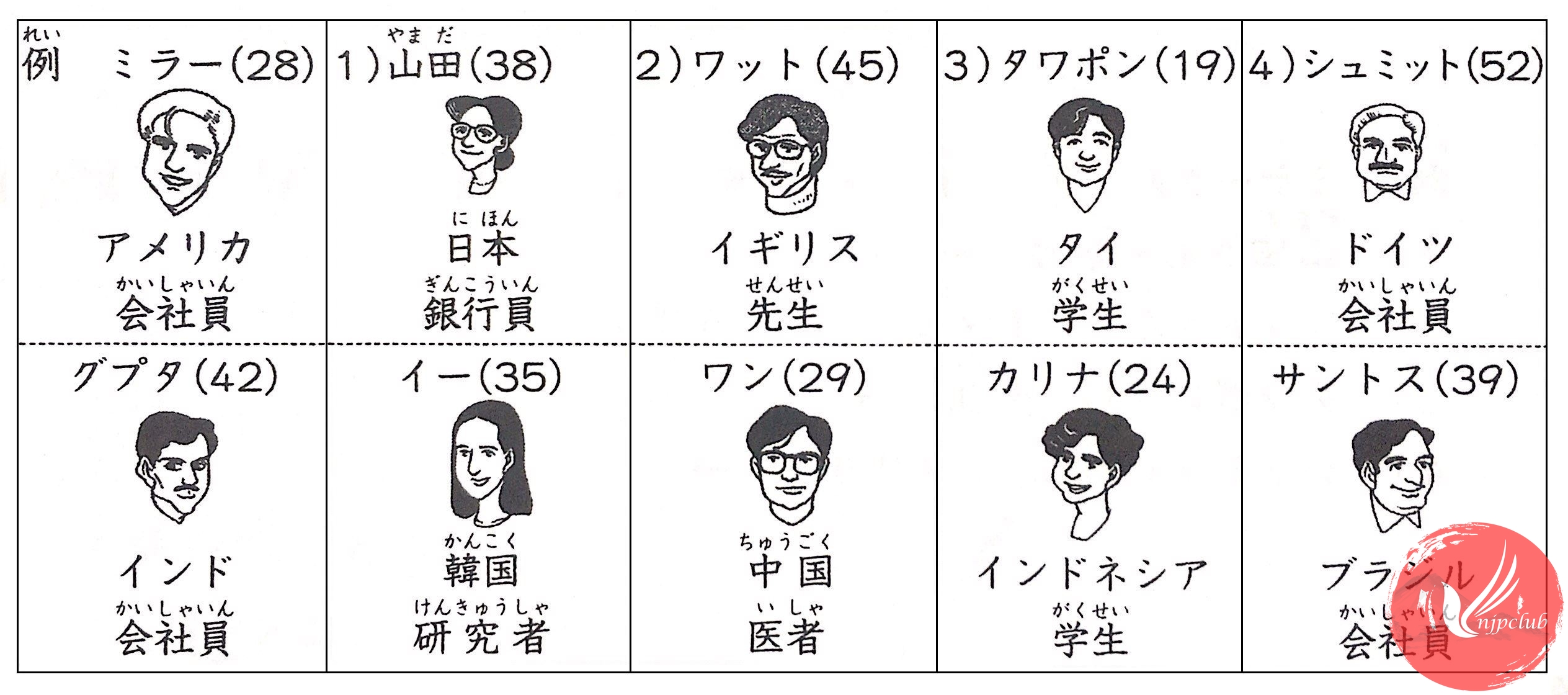
Part 6: Complete sentences similar to the example using the information in the picture

例
1:
ミラーさん・かいしゃいん、グプタさん
→ ミラーさんは かいしゃいんです。グプタさんも かいしゃいんですか。
Mr. Miller is a company employee. Is Mr. Gupta also a company employee?
… はい、グプタさんも かいしゃいんです。
Yes, Mr. Gupta is also a company employee.
例
2
:
ミラーさん・アメリカじん、グプタさん
→ ミラーさんは アメリカじんです。グプタさんも アメリカじんですか。
Mr. Miller is American. Is Mr. Gupta also American?
… いいえ、グプタさんは アメリカじんじゃ ありません。
No, Mr. Gupta is not American.
Complete the following sentences:
1)やまださん・ぎんこういん、イーさん →
2)ワットさん・せんせい、ワンさん →
3)タワポンさん・がくせい、カリナさん →
4)シュミットさん・ドイツじん、サントスさん →
««« Answer key »»»
1)やまださんは ぎんこういんです。イーさんも ぎんこういんですか。
Ms. Yamada is a bank employee. Is Ms. Lee also a bank employee?
… いいえ、イーさんは ぎんこういんじゃ ありません。
No, Ms. Lee is not a bank employee.
2)ワットさんは せんせいです。ワンさんも せんせいですか。
Mr. Watt is a teacher. Is Mr. Wang also a teacher?
… いいえ、ワンさんは せんせいじゃ ありません。
No, Mr. Wang is not a teacher.
3)タワポンさんは がくせいです。カリナさんも がくせいですか。
Mr. Thawaphon is a student. Is Ms. Karina also a student?
… はい、カリナさんも がくせいです。
Yes, Ms. Karina is also a student.
4)シュミットさんは ドイツじんです。サントスさんも ドイツじんですか。
Mr. Schmidt is German. Is Mr. Santos also German?
… いいえ、サントスさんは ドイツじんじゃ ありません。
No, Mr. Santos is not German.
Part 7: Complete sentences similar to the example using the information in the picture
例
1:
ミラーさん
Complete the following sentences:
1)やまださん →
2)ワットさん →
3)タワポンさん →
4)シュミットさん →
««« Answer key »»»
3)タワポンさんは なんさいですか。
How old is Mr. Thawaphon?